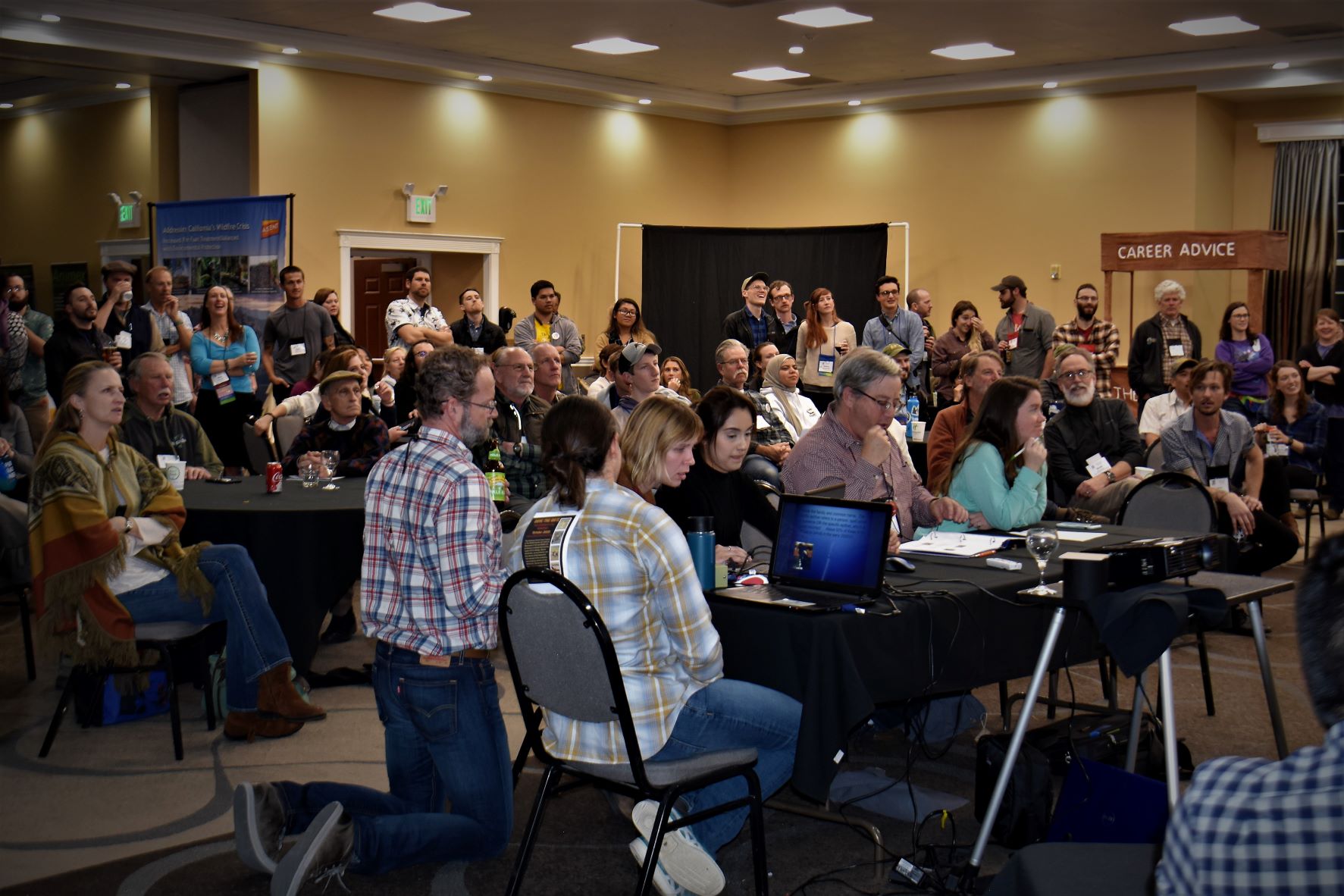
Student Team Trivia
Tuesday, February 3, 2026
- 8:00-9:30pm, First round – New, fast and fun
Teams of four wildlife undergraduate students will all answer the same general wildlife knowledge questions (which will have a strong reliance on taxonomy, morphology and wildlife management techniques). We will invite two of the most successful teams to return for a head-to-head competition on Thursday night (more information on that can be found below). A friendly suggestion: mix up your team! If all four team members are expert ornithologists, you might not succeed. Your team will likely be more effective if each team member has a different core knowledge area, to include ornithology, mammalogy, herpetology, statistics, management techniques, regulations, policy, wildlife history and so on…
Thursday, February 5, 2026
- 8:30pm to 9:00pm, Student Team Trivia Finals – A semi-traditional Quiz Bowl final match
This final match format will be a fast and FUN competition between two teams of students from the competition on Tuesday night. It will feature more questions on population ecology, wildlife management techniques, zoology, and statistics. Participants will also be challenged to identify skulls and study skins, spell challenging scientific names, expound on wildlife management history and more. BOTH teams will win notable prizes and even some glory!
We’re recruiting teams for the 2026 competition. Teams will be 4 undergraduate students ideally all connected to a single university (with no limit to the number of teams than can represent a university), or “mixed” teams representing many schools. So, if there are students who are interested in the competition, please let us know.
Graduate students, we hope to include you starting in 2027, but if you’d like to contribute to the 2026 event, we’d welcome a few volunteers and you may even be able to provide us with some questions!
Contact Rhys Evans to sign up, or for more information: sirsnave@verizon.net.
For more information on the traditional TWS Quiz Bowl, and how it works — check out this description by TWS.